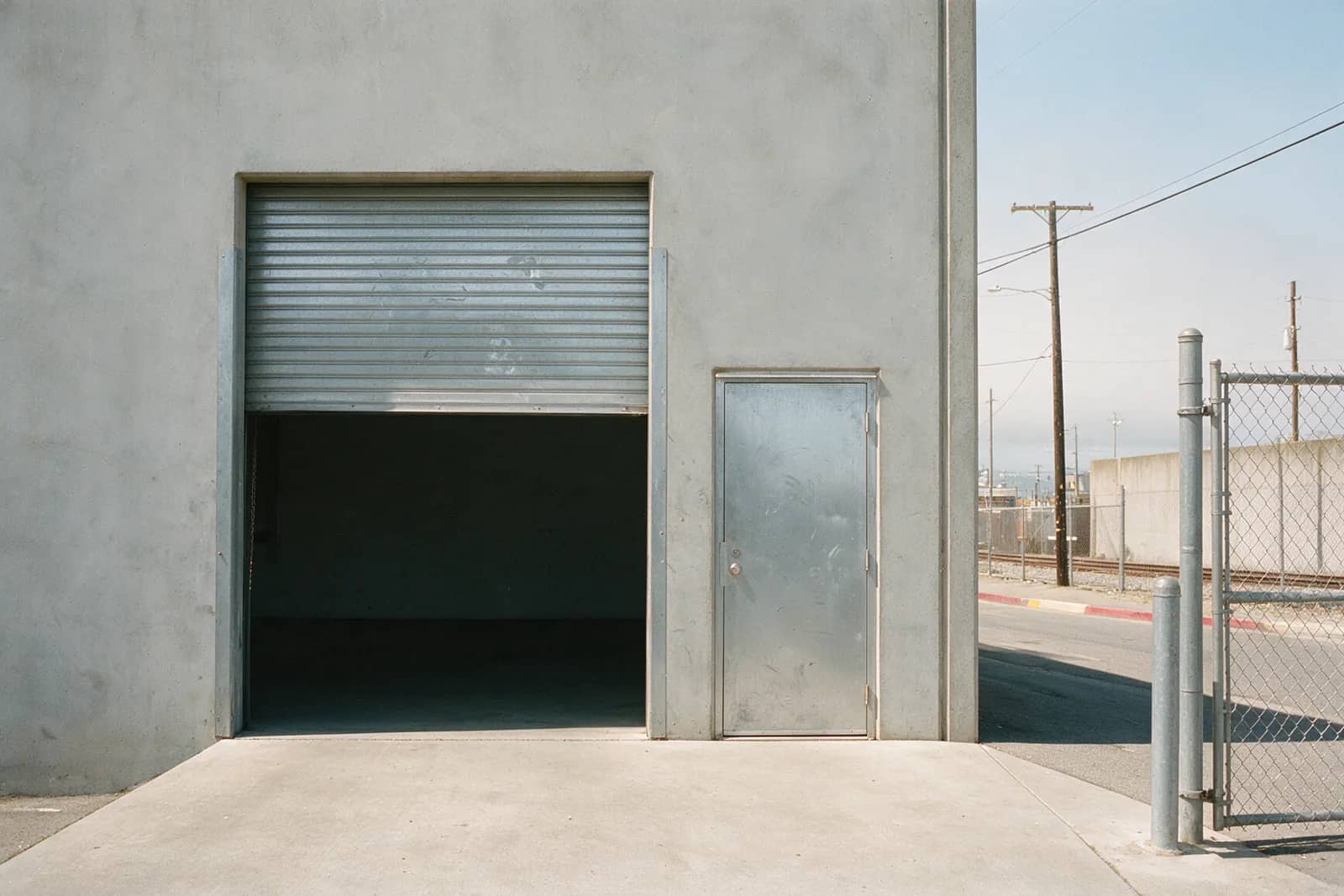
Two doors in the same wall
Between Davis Street and Alvarado, west of the tracks, most buildings are put together the same way. A tilt-up or a steel shell, a roll-up wide enough to back a truck into, and a steel man-door set into the wall a few feet off to one side. Sometimes there is a small office at the front with a glass door on Davis Street itself, and behind it the floor, the racking and the roll-up at the back.
Owners tend to think of the roll-up as the door that needs the lock, because it is the big opening and the stock is behind it. In practice it is the other way around. The roll-up gets raised twice a day, closes under its own weight and is fastened with something simple. The man-door gets pulled open and slammed forty times a shift by people carrying things, and it is the door that produces the call. Two doors, two different sets of problems, and it is worth saying which is which on the phone so the right parts come out of the van.
What actually holds a roll-up down
On a sheet-curtain roll-up the fastening is usually a slide bolt at each side of the bottom bar, dropped into a keeper welded to the track, with a padlock through the eye of one of them. On a lighter door there may be a T-handle in the middle of the bottom bar with a small wafer cylinder in it, and on a chain-hoist door the chain itself gets a padlock through the keeper so the hoist cannot be turned. None of those is a sophisticated lock and none of them is meant to be. The strength of a closed roll-up is the door, the track and the bottom bar, not the cylinder.
So the thing that fails out here is nearly always the padlock. A padlock hanging in a doorway two blocks from the shoreline takes fog off the bay every night, and a body full of wet grit stops turning long before anybody notices. The answer is a padlock with a shrouded body and a stainless shackle, sized so the shackle fills the keeper instead of leaving three inches of it exposed, and the same key across every padlock in the yard so the driver is not sorting a ring at six in the morning. Where a padlock takes a rekeyable cylinder, keying the set alike is $26 to $42 per cylinder. Where it does not, it is a padlock and it gets swapped.
The man-door does the real work
The man-door beside the roll-up is a steel slab in a steel frame, and what is on it is usually a rim cylinder with a latch, a deadbolt above it, or a mortise set in the edge on the older buildings. That door carries everything the roll-up does not: the people, the parts runner, the two shifts that overlap, the cleaner on Sunday. Work on that kind of door, and on the glass front door of the office, runs $155 to $449 depending on which door it is and what goes on it.
The single most useful thing an owner can decide about the man-door is whether it should be lockable from the inside at all while the floor is running. A man-door chained or padlocked shut from the inside so nobody can wander in is a fire exit that no longer works, and it is the arrangement that gets a shop written up. If people are inside, that door has to let them out with one motion and no key. What can be done instead is to make the outside of it dead: no lever, a plain pull, and entry by key or by fob only. That way nothing pushes open from the alley and nothing traps anybody in.
The faults that are alignment, not hardware
A good half of the calls from the belt are not lock faults. A steel building moves. The slab settles, a forklift clips a jamb, a truck backs into a bollard that is welded to the same slab as the frame, and after that the bolt no longer lines up with its keeper. The symptom is a door that has to be lifted, leaned on or kicked at the bottom before the key will turn. The lock in that door is fine. It is being asked to throw a bolt into a hole that has moved a quarter of an inch.
The same goes for a roll-up whose bottom bar has taken a knock. A bent bar means the slide bolts no longer meet their keepers, and the usual field repair is to force the bolt with a bar until something gives. Straightening, re-drilling a keeper or moving a strike is ordinary work and it costs far less than hardware. A technician who quotes a new lock for a door that has not been checked for alignment has quoted the easy answer. On these buildings the door gets tried first, hinges, closer, strike and bar, and the hardware comes up only if the hardware is what is broken.
Who carries which key on a yard running three shifts
The other half of the trouble on Davis Street is not mechanical. A yard with three shifts, a parts runner, two drivers and a cleaning crew ends up with a key population nobody has ever counted. Somebody left in 2021 and their key went home in a jacket. The night lead has a copy cut at a hardware counter. The cleaner has the man-door but also, because it was easier once, the office. Nobody can say how many keys open the back door, and that is a question worth being able to answer.
Two ways out of it, and which one fits depends on how often people change. A master key system puts every lock on the site into one order, so a shift lead carries one key for the man-door, the office and the roll-up padlocks, a driver carries a key that passes only the yard, and the owner carries one that passes everything. That is quoted for the site once the doors are counted. Where staff turn over often, access control on the man-door is the better answer, because a person who leaves is removed from a list in a minute and nothing on the door has to change. That is quoted too, on the doors and the readers rather than off a list.
Early starts, late lockouts and the figures
The van works off Davis Street, so the belt is the first run of the morning and about seventeen minutes from the yard. Across San Leandro it is fifteen to thirty minutes depending on the district. A shop shut out of its own building is a business lockout at $129 to $239, opened without harm to the door, and the $89 visit is already counted inside that figure rather than added to it. A door forced overnight and found at opening time is a repair at $165 to $419, covering the frame, the strike, the cylinder and whatever else took the load, described in plain words on the receipt for an insurer.
Estudillo Security works to The Same Number Twice. One figure gets said on the call, and it carries the visit, the labor and the parts inside it. That same figure is what appears on the receipt, whatever the technician finds when the door is open. The lock is opened without harm first, and if drilling is the only way left, it waits for your word and it does not raise the number. Card or tap at the door, an itemized receipt by email, and a written line naming the doors and the work when a manager or an insurer needs one for the file. Calls answered 24/7, with $45 sitting inside the figure between 8pm and midnight and $80 between midnight and 7am, which moves a late call up within its range rather than past the top of it.
Quick answers
What should be on a roll-up door on Davis Street?+
Slide bolts into welded keepers, with a shrouded padlock sized so the shackle fills the keeper. The door and the track do the holding; the padlock only stops the bolt sliding. Keying every padlock in the yard alike costs $26 to $42 per cylinder where the padlock takes a rekeyable cylinder, and saves a driver sorting a ring at six in the morning.
Can we padlock the man-door shut from the inside while the floor is running?+
No. If people are inside, that door has to open with one motion and no key. What can be done instead is to make the outside of it dead, with a plain pull and no lever, so entry is by key or by fob only and nobody is shut in.
Our back door has to be lifted before the key turns. Is that a new lock?+
Usually not. A steel building settles and a knock to the jamb moves the keeper a quarter inch, so the bolt is being asked to enter a hole that is no longer there. Hinges, closer, strike and bottom bar get checked first, and realignment costs far less than hardware. Door work here runs $155 to $449 when hardware genuinely is the problem.
Need it handled rather than read about?
(510) 901-3716More guides