Why the bar comes up at all
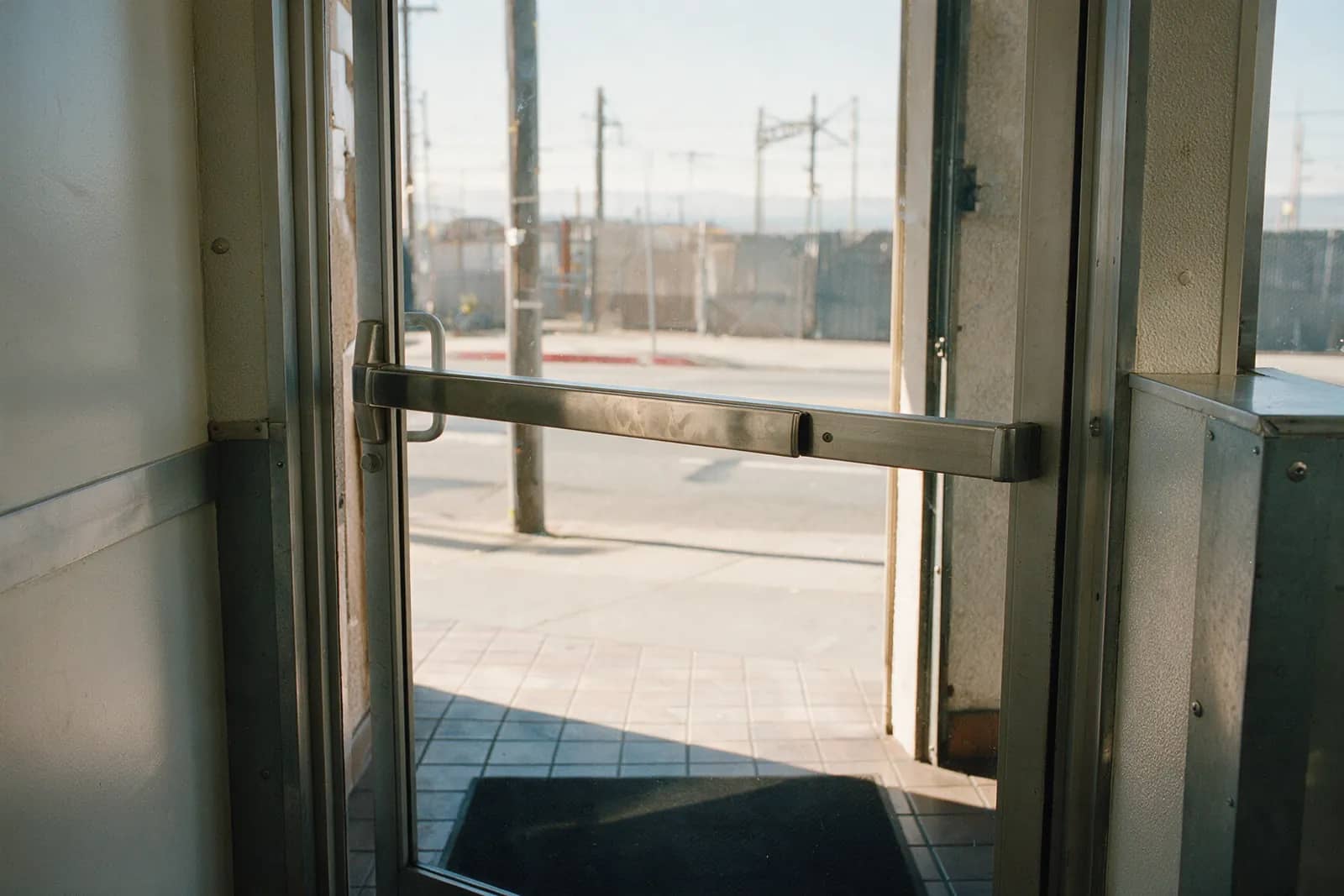
Panic hardware turns up on East 14th and Washington Avenue for three reasons. A space that used to be retail is becoming a restaurant or a bar, and what the room is used for has changed what the exits have to do. A tenant is taking over a shop and an inspection has raised the back door through the stockroom. Or the existing bar has been on that door since the nineties, the latch no longer catches, and it has to be replaced rather than patched.
Whichever it is, the decision about what goes on the door is not really the locksmith's and it is not the tenant's either. What the room is used for, how many people are in it and how many exits it needs is the inspector's call. What a locksmith does is fit hardware that matches what is being asked for, and say clearly when a door as it currently hangs cannot take it. The useful conversation happens before anything is ordered, and it is six questions long.
Which way does the door swing
This is first because it decides everything after it. An exit device pushes. A person walking into the door at speed puts their weight on the bar and the door leaves ahead of them. That only works if the door swings outward, away from the room. A door that opens inward cannot take a panic bar in any useful way, and no amount of hardware changes that.
Plenty of back doors on this street open inward, because they were fitted as stockroom doors and nobody was thinking about people leaving in a hurry. Turning one around is not a lock job. It is a frame job: the stop is on the wrong side, the hinge preparation is on the wrong jamb, the threshold and the weather detail are wrong, and often the door itself has to be replaced along with the frame. That is worth knowing on day one of a lease negotiation rather than the week before opening, because it is the item with the longest lead time in the whole conversation.
What the frame is made of, and how many leaves
The second question is what the door and frame actually are, because the device has to match them. A single steel door in a steel frame, which is most back doors on the works side of the street, takes a rim device: the mechanism sits on the face of the door and the latch catches a strike on the frame. That is the straightforward case and it sits at the lower end of what these cost.
An aluminum storefront door, the glass one facing East 14th, is a different animal. The stile is narrow, the glass leaves little room, and the device usually has to be a narrow-stile type with a concealed or surface vertical rod. A pair of doors with no center post needs rods top and bottom on at least one leaf and often a removable mullion, and the two leaves have to be set up so they close in the right order. That is why exit devices come as a range of $289 to $739 per door: a rim device on a single steel door and a concealed vertical rod pair on a glass front are the same category of hardware doing very different amounts of work. Where the door does not need an exit device at all and simply needs a proper lock, storefront door hardware runs $155 to $449.
What happens to the outside of that door
Once a bar goes on the inside, a decision has to be made about the outside, and this is the question shops most often skip. Three arrangements are normal. A plain pull with no way in, which is right for a back door that staff enter through the front. A keyed lever or knob trim, so somebody with a key can come in through the back. Or a cylinder that only retracts the latch, which behaves like a night latch.
The one to think about is keyed trim, because it puts a cylinder on a door that opens into the alley behind the block. That cylinder becomes part of the shop's key count and should be on the same key as the front, not on a spare from the box. Rekeying it later, when a member of staff leaves, is $26 to $42 per cylinder like any other. Whatever goes on the outside, the inside stays the same: one push, no key, no thumbturn, no second action. Anything that adds a step on the inside undoes the point of the device.
Dogging, and the two arrangements that get a shop written up
Dogging is a feature on many devices that holds the latch retracted so the door is push-pull during business hours. On a front door that is genuinely useful, and it means the bar is not being latched and unlatched two hundred times a day. It also means the door is unlocked, which is the part people forget. A bar dogged on Sunday morning by somebody who dogged it Saturday afternoon is a shop standing open. Whoever closes needs to know how to undog it, and on a device with a keyed dogging cylinder that is one turn of a key, which is a good reason to specify the keyed type on a front door.
Two arrangements come up again and again and both cause trouble. The first is a chain and padlock through the bar or the pull while people are inside. It happens on late nights when staff want the back door secure, and it turns a working exit into a locked one. The second is a thumbturn deadbolt fitted above a panic bar, usually added years after the bar went on, because somebody wanted the door more secure at night. Now leaving requires two actions instead of one. If the door needs to be more secure after hours, the answer is on the outside of it and in the trim, not in a second bolt on the inside.
Counted per door, and the figures
Exit devices are counted per door, which is how the figure gets said before anybody visits. A shop with a front pair on the street and one steel back door is three leaves, and each is priced for what it needs rather than averaged. Panic bars and exit devices are $289 to $739 per door. Storefront door locks are $155 to $449. Rekeying trim cylinders is $26 to $42 each. A shop locked out of its own premises on a Sunday afternoon is a business lockout at $129 to $239. Every one of those already includes the $89 visit.
The van works out of Davis Street and reaches downtown and East 14th in about fifteen minutes, with fifteen to thirty minutes covering the rest of San Leandro. The Same Number Twice is the arrangement: the figure gets said on the call with the visit, the labor and the parts inside it, and the unit it is counted in gets said with it, per door here rather than per hour. The receipt carries that same figure. Nothing gets forced or drilled while there is an intact way in, and if that step is ever the only one left it waits on your word and does not raise the number. Card or tap at the door, itemized receipt by email, and a written line naming the doors and the devices for a landlord, a manager or an insurer. Calls answered 24/7, with $45 inside the figure from 8pm to midnight and $80 from midnight to 7am, which lifts a late call within its range and not past it.
Quick answers
What does a panic bar cost on a shop door on East 14th?+
$289 to $739 per door, with the $89 visit inside that figure. A rim device on a single steel back door sits at the bottom of the range; a narrow-stile device with concealed vertical rods on a glass storefront pair sits at the top. Each leaf is counted separately, so the figure can be said on the call once the doors are described.
My back door opens inward. Can it take a panic bar?+
Not as it hangs. An exit device works by being pushed, so the door has to swing outward, away from the room. Turning a door around is a frame job rather than a lock job, and often means a new door and frame together. It is worth raising during a lease negotiation, not the week before opening.
Can we put a deadbolt above the panic bar for nights?+
No. That makes leaving a two-step job and undoes what the device is for. If the door needs to be more secure after hours, the answer is on the outside of it: a plain pull with no entry, or keyed lever trim on the shop's own key, rekeyable at $26 to $42 per cylinder when staff change.
Need it handled rather than read about?
(510) 901-3716More guides