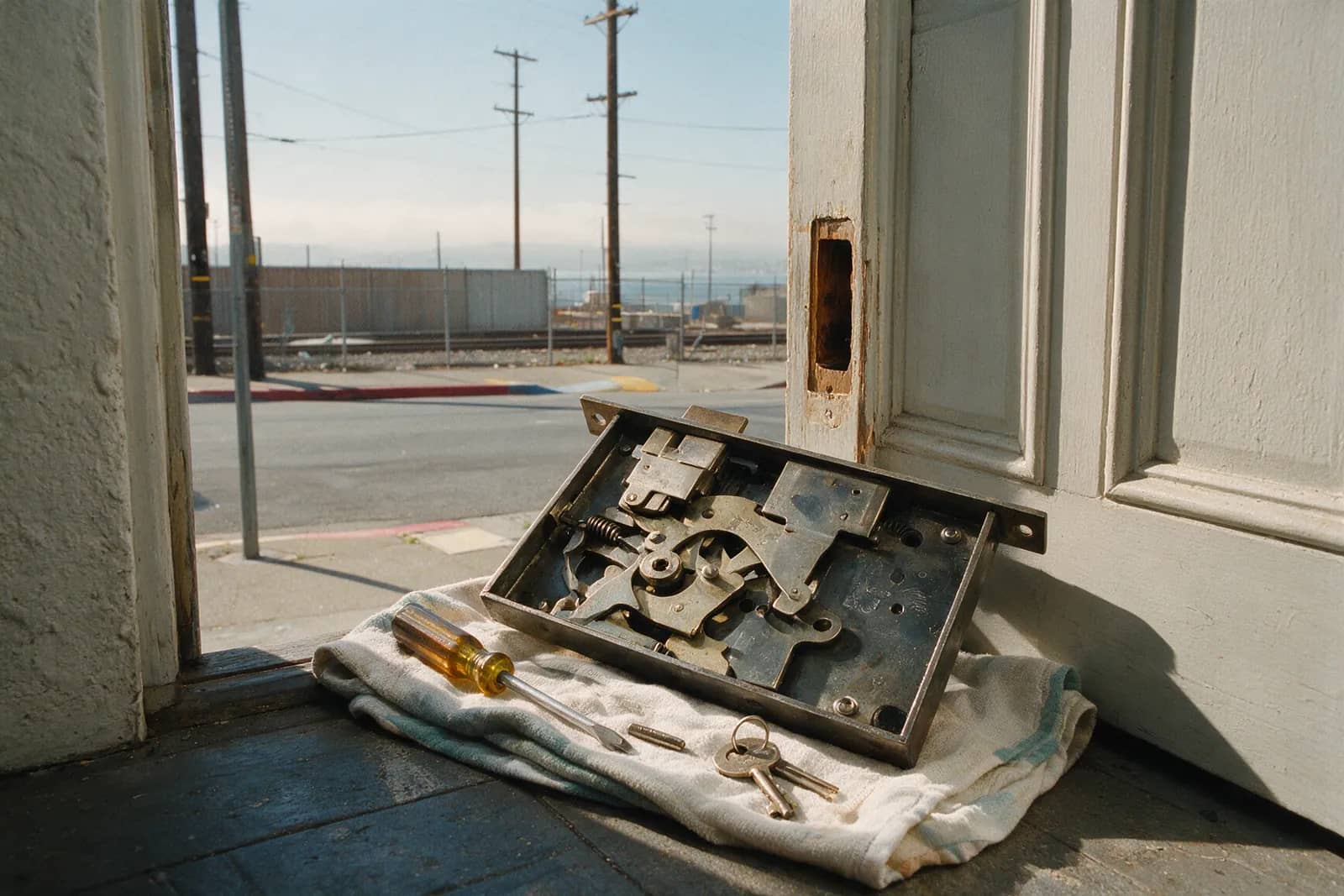
What is in the edge of the door
A house built on these streets in the twenties, thirties or forties does not have a lock bored through the face of the door. It has a pocket chiseled into the edge of the stile, and a rectangular steel case dropped into that pocket. Knobs on a square spindle run through the case, a latch comes out of one side of it, a bolt comes out above the latch, and a long plate on each face of the door covers the lot. That is a mortise lock, and on a lot of houses near the Casa Peralta it is the original one.
It is a better piece of engineering than most of what has replaced it. The case is steel, the parts inside are cast and machined rather than stamped, and it has already run for ninety years on doors that get used every day. The reason people ask about it is almost never that it has failed. It is that the house has changed hands, or a tenant moved out, or a set of keys never came back, and somebody wants the old keys to stop working. That is a rekey, and whether a rekey is even possible depends entirely on what kind of mortise lock is in the door.
Look at the key, not at the door
There is a quick test and it does not need a technician. Look at the key you already have. If it is a flat blade with a wavy edge, cut on one side or both, and there is a small round cylinder face with a keyway in it somewhere on the outside plate, then the case has a threaded cylinder screwed into it. That cylinder has pins in it, and pins can be changed.
If the key is a long shaft with a flat rectangular bit sticking off the end, the sort people call a skeleton key, then there are no pins anywhere in that lock. It is a warded or lever lock. The bit passes obstructions cast into the case and lifts the bolt directly. There is nothing to repin, which is why a technician who promises to rekey a bit-key lock has either not seen it or is about to change the whole lock and call it something else. Most Estudillo Estates and Best Manor houses have both: a cylinder on the front door where somebody upgraded it decades ago, and original bit-key hardware still on the bedroom and closet doors inside.
Rekeying the threaded cylinder
Where the mortise case does have a cylinder, the work is simple and nothing about the door changes. A small set screw in the edge of the door is loosened, the cylinder unscrews out of the case like a bolt out of a nut, the pins are changed to a new key, and it screws back to the same depth so the cam still meets the lock. That is $26 to $42 per cylinder, the same figure charged on a modern deadbolt, because the work inside the cylinder is the same work.
The two details worth naming are depth and count. Depth, because a mortise cylinder that is screwed in one turn too far or one turn short will either bind the cam or fail to throw the bolt, and a door that worked before the visit and sticks after it was not set back correctly. Count, because a house like this has more cylinders than people remember. The front door, the back door off the kitchen, the side door onto the driveway, the detached garage at the end of it, the basement door, and sometimes a gate. Five or six is normal. Counting them on the call is what settles the figure, since the visit is counted once for the house no matter how many cylinders are on the list.
The bit-key lock that cannot be rekeyed, and what to do instead
For a bit-key mortise there are three honest options and they get named with the lock in front of you rather than over the phone. The first is to leave it alone. On an interior door, a bedroom or a closet, the lock is doing no security work at all and the key that opens it also opens most bit-key locks in Alameda County. Nobody is protecting anything with it. Keeping the original hardware on an interior door costs nothing and is usually the right call.
The second is a retrofit on an exterior door. A modern threaded cylinder can be fitted into some older mortise cases, either directly or with a plate, so the case, the knobs and the long escutcheon stay exactly where they are while the key becomes a key nobody else has. That sits in lock replacement and installation at $115 to $299 per door, and whether a given case will accept it is a matter of what is inside the case, not of what the outside looks like. The third is a deadbolt fitted above the mortise, leaving the original as a latch. That last one puts a new hole in a ninety-year-old stile, so it gets discussed before anything is cut, not after.
Ninety years of grease, paint and one wrong screw
Separately from the key, these cases develop their own complaints. The grease packed into them in 1936 has long since dried to a varnish, so the bolt moves slowly and the knob comes back lazily. A spring inside snaps and the knob droops. The square spindle wears round at the corners and the knob spins without moving anything. Somebody at some point drove a screw through the face plate into the case and stopped the bolt traveling. And every one of these houses has had the door painted enough times that the paint itself has become part of the problem.
Most of that is a clean and a service rather than a replacement, and it is worth doing while the lock is out for a rekey since the case is already off the door. What genuinely finishes a mortise case is a cracked casting or a worn hub, and at that point a replacement case that fits the same pocket is the sensible answer, keeping the original knobs and plates on the door where they still fit. Nobody should be selling a new set of hardware for a house on these streets because the old one was slow. Slow is dried grease.
The morning half of the day, and the figures
Rekeys on these streets are morning work. The van reaches Estudillo Estates and Best Manor in about fifteen minutes, and it is fifteen to thirty minutes across the rest of San Leandro. A rekey is $26 to $42 per cylinder with the doors keyed alike so one key runs the house. A retrofit or a replacement is $115 to $299 per door with the make named before it goes on. A house lockout, which on these doors is picked rather than forced because the plate around the lock has not been manufactured since before the war, is $119 to $205. The $89 visit is inside each of those figures already.
The Same Number Twice is how this works. The figure gets said on the call, with the visit, the labor and any parts inside it. The receipt afterwards shows that same figure, whatever turns up once the case is out of the door. Nothing gets drilled while there is a way to open it intact, and if drilling is genuinely the last option it happens only when you have said so and the number does not move because of it. Card or tap at the door, itemized receipt by email, and a written line for an insurer or a manager when one is wanted. Calls answered 24/7, with $45 inside the figure from 8pm to midnight and $80 from midnight to 7am, which places a late call higher in its range rather than above it.
Quick answers
Can an original mortise lock on an Estudillo Avenue house be rekeyed?+
Only if it has a threaded cylinder in it, which you can tell from the key: a flat blade with a wavy edge means pins, and pins can be changed at $26 to $42 per cylinder. A long shaft with a flat bit on the end is a warded lock with no pins in it, and nothing can be repinned.
What can be done about a bit-key lock on an exterior door?+
Three options, named with the lock in front of you. Leave it, which is right on interior doors. Retrofit a modern cylinder into the existing case so the knobs and the long plate stay on the door, at $115 to $299. Or add a deadbolt above it, which means cutting a new hole in an old stile and gets agreed before anything is cut.
The bolt on my old lock moves slowly. Does the lock need replacing?+
Almost never. The grease packed into these cases decades ago has dried to a varnish, and a clean and service while the case is out for a rekey usually fixes it. A cracked casting or a worn hub is what actually finishes one, and then a replacement case can go into the same pocket with the original knobs and plates kept on the door.
Need it handled rather than read about?
(510) 901-3716More guides